Also known as: Hotchkiss shell, Hotchkiss shot.
| Class | Rifled-artillery projectile system |
|---|---|
| Patentees | Andrew Hotchkiss; Benjamin B. Hotchkiss |
| Forms | Solid shot, explosive shell, case shot; canister supplied for compatible guns |
| Mechanism | Gas-pressure expansion of a soft lead band |
| Civil War calibers documented | 2.6, 3, 3.67, and 3.8 inches, among others |
| Fuze relationships | Time and percussion fuzes; Hotchkiss percussion fuze |
Patent lineage
The design should not be attributed to only one member of the Hotchkiss family. Andrew Hotchkiss received U.S. Patent 13,679 on October 16, 1855, for a three-part rifled-cannon projectile using a flexible lead ring and movable cap. Benjamin B. Hotchkiss received U.S. Patent 29,272 on July 24, 1860, for a further improvement in projectiles for rifled ordnance.
Construction and operation
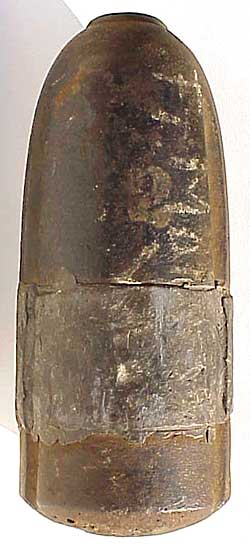
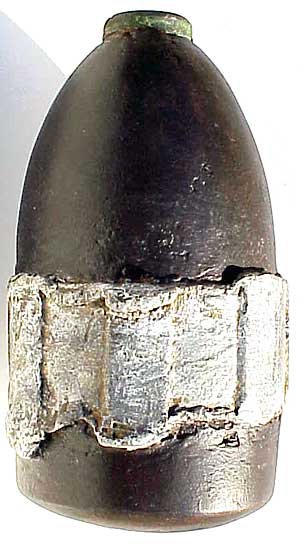
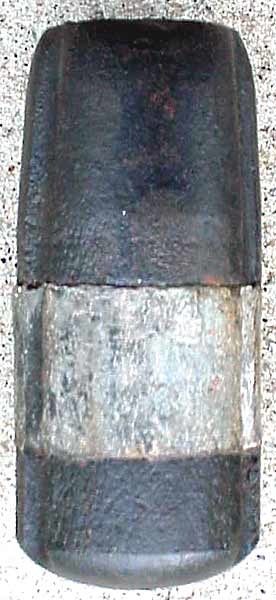
Quincy A. Gillmore described the Hotchkiss projectile as a body, an expanding soft-metal ring, and a cap. On discharge, the cap was forced against the ring so the ring expanded into the rifling. The West Point ordnance catalogue likewise described a cast-iron body and base connected by lead, with powder gas forcing the base forward to expand the lead into the grooves.
Recovered examples may lack the lead band, the movable base, or both. Attribution must therefore use the remaining interfaces, dimensions, form, and provenance rather than requiring a complete assembly.
Forms, fuzes, and procurement
Official Ordnance Office correspondence records wartime orders to Hotchkiss & Sons for shot, shell, case shot, and canister in multiple calibers. Shells could use time or percussion fuzes. Some case-shot bodies have longitudinal channels intended to convey flame from the propelling charge toward a time fuze.
Sources & further reading
- Andrew Hotchkiss. Improved Projectile for Ordnance. U.S. Patent 13,679, October 16, 1855.
- Benjamin B. Hotchkiss. Improvement in Projectile for Rifled Ordnance. U.S. Patent 29,272, July 24, 1860.
- U.S. House of Representatives. Contracts for Ordnance, Projectiles, and Small Arms. 40th Congress, 2nd Session, Executive Document No. 99. Washington: Government Printing Office, 1868.
- Gillmore, Quincy A. Official Report to the United States Engineer Department, of the Siege and Reduction of Fort Pulaski, Georgia, February, March, and April, 1862. New York: D. Van Nostrand, 1862.
- Hackley, Frank W. Civil War Explosive Ordnance. Revised November 10, 1960. U.S. Naval School, Explosive Ordnance Disposal.
- Whittemore, James M., and F. Heath. Ammunition, Fuses, Primers, Military Pyrotechny, Etc. Ordnance Memoranda No. 21. Prepared under Brig. Gen. Stephen V. Benet. Washington: Government Printing Office, 1878.