Because the
Confederates desperately needed lead for small arms ammunition, they used iron rather than
lead for case-shot material. This presented a difficult situation, as they could not
drill into the iron balls to form the bursting cavity without damaging the drill bits or
breaking the matrix loose. The bursting cavity was formed by inserting a dowel into
the fuze opening. The iron balls were inserted through the hole on the projectile's
side, and the hot liquefied matrix was poured into the side-loading hole.
After the
matrix cooled, the dowel was removed, a lead plug screwed into the loading hole, powder
installed and the fuze adapter screwed into the nose of the projectile. Side-loading
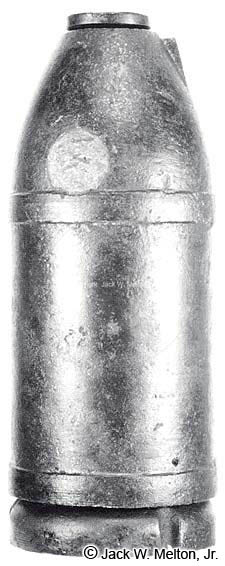
rifled projectiles are rare. The projectile pictured has three frame grooves cut
into the sabot, a lathe dot (or lug) near the top of the nose, a lathe dimple in the base,
and was loaded with iron case-shot balls.